
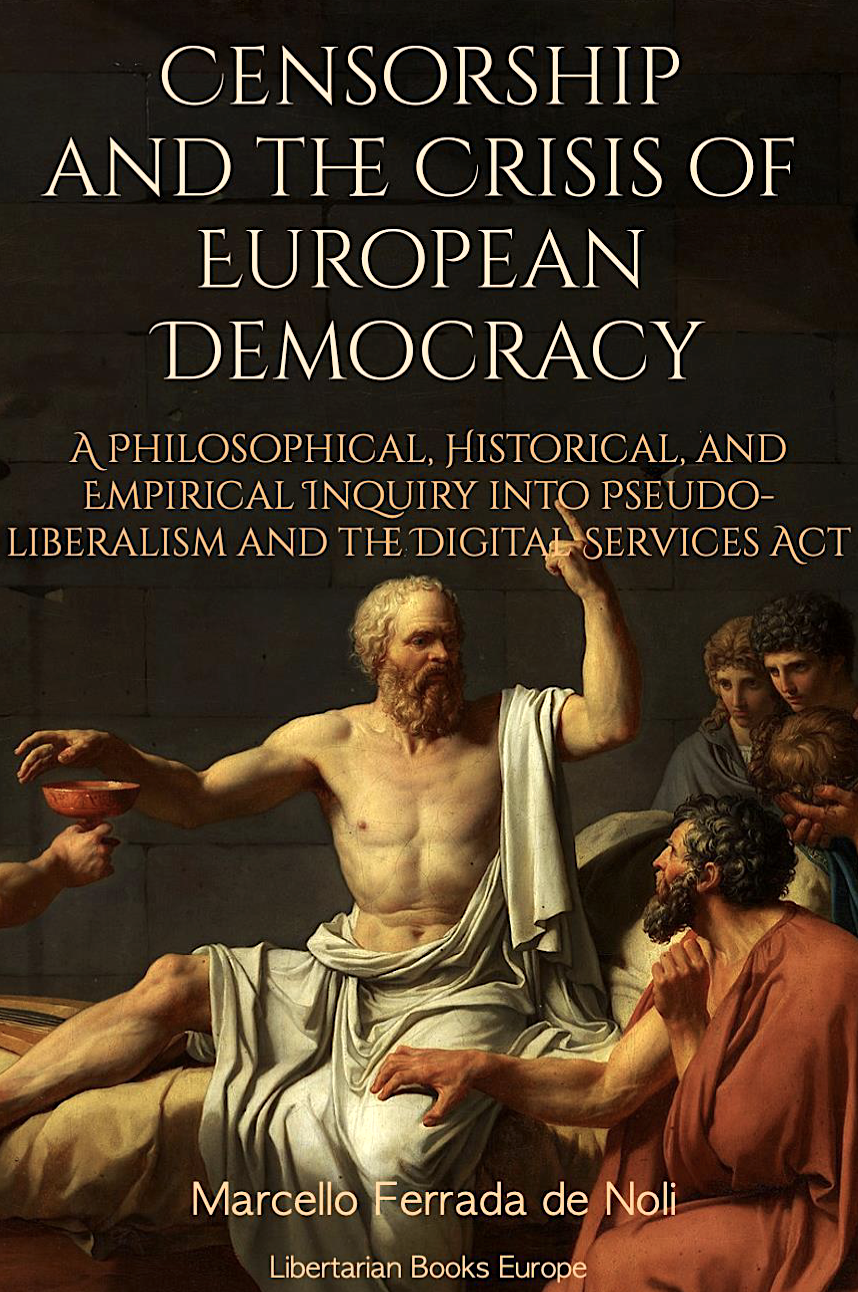
 Censorship and the Crisis of European Democracy –A Philosophical, Historical, and Empirical Inquiry into Pseudo-Liberalism and the Digital Services Act
©Marcello Vittorio Ferrada de Noli
Libertarian Books Europe
Stockholm, Bergamo
Pages 1-326
ISBN 978-91-88747-29-7
Copyright ©2026 Marcello Vittorio Ferrada de Noli
License: Creative Commons Attribution 4.0 International
Cover: Jacques-Louis David, The Death of Socrates (1787). Metropolitan Museum of Art
Description
This book offers a comprehensive philosophical, historical, and empirical examination of the erosion of freedom of expression in contemporary Europe, with particular focus on the European Union’s Digital Services Act (DSA). Situating current censorship practices within the long tradition of democratic theory, the study traces the inseparability of democracy and free speech from classical Athens to modern constitutional liberalism.
Drawing on classical political philosophy (Socrates, Voltaire, Montesquieu, Mill, Rawls), the book argues that freedom of expression is not an accessory civil liberty but a structural precondition for democratic legitimacy. Through historical comparison, the work demonstrates how political movements and institutions founded on emancipatory ideals have repeatedly undergone metamorphoses into systems of repression—often justified in the language of safety, harm prevention, or moral necessity.
The empirical core of the book documents contemporary mechanisms of censorship in Europe, including algorithmic suppression, shadow banning, platform governance, and the outsourcing of regulatory enforcement to private digital actors. Particular attention is given to the DSA’s concentration of power in unelected EU institutions and its extraterritorial ambitions, raising fundamental questions of sovereignty, accountability, and compatibility with international human-rights norms.
Case studies examine the impact of censorship on academics, journalists, alternative media, online encyclopaedias, and AI knowledge systems. The book also analyses emerging counter-models of epistemic governance, arguing for pluralism, transparency, and competition as democratic safeguards in the digital knowledge ecosystem.
Ultimately, this volume contends that contemporary European censorship practices represent a form of pseudo-liberalism that inverts the core principles of classical liberal democracy. By restricting dissent and narrowing the public sphere, such practices risk transforming democratic systems into simulations of deliberation rather than arenas of genuine political accountability.